The Method of Methodism
"By Methodists I mean a people who profess to pursue holiness of heart and life ..." John Wesley

Part 1
How are disciples made? The mission of The United Methodist Church is “to make disciples of Jesus Christ.” The church believes that the local congregation is the context of disciple-making. Congregations are present in towns, neighborhoods, and cities as outposts of the Church. God is worshiped, sacraments are celebrated, and the gospel is proclaimed in the world through the witness of the people. The local congregation is the place where disciples are made because it is where the church intersects with the world.
If disciples are made then it seems that we can say with some certainty there is a method for making them. A person does not become a disciple by accident. Making something requires intention and planning. It is a process in which the materials are shaped, formed or assembled into something new and different. For example when a factory sets out to make an automobile it begins with a set of parts and a step-by-step procedure for assembling the parts into a working automobile. The various parts are assembled by the hands and labor of many people with varying skills and training. At each stage of the process the work-in-progress is examined for quality. Each person involved contributes to the final goal of a car that works dependably and satisfies the customer. Nothing is left to chance or accident. Every step of the manufacturing process is well planned and executed by trained mechanics.
Making disciples is in some ways like making a car. However, this is probably not the best illustration. Such a manufacturing process does not apply to human beings well because the goal of an assembly line is automobiles that are identical. The first car is the same as the 100th car is the same as the 1000th. The goal of disciple-making cannot be to produce people who are identical. A more appropriate example for disciple-making is making pottery. We find this in Scripture
Yet, O LORD, you are our Father;
we are the clay, and you are our potter;
we are all the work of your hand. (Isaiah 64:8)
So I went down to the potter’s house, and there he was working at his wheel. The vessel he was making of clay was spoiled in the potter’s hand, and he reworked it into another vessel, as seemed good to him.
Then the word of the Lord came to me: Can I not do with you, O house of Israel, just as this potter has done? says the LORD. Just like the clay in the potter’s hand, so are you in my hand, O house of Israel. (Jeremiah 8:3-6)
The precious children of Zion,
worth their weight in fine gold--
how they are reckoned as earthen pots,
the work of a potter’s hands! (Lamentations 4:2)
Has the potter no right over the clay, to make out of the same lump one object for special use and another for ordinary use? (Romans 9:21)
Like clay in the hand of the potter,
to be molded as he pleases,
so all are in the hand of their Maker,
to be given whatever he decides. (Sirach 33:13)
The image of potter and clay is appropriate for disciple-making because people are like the clay. Each type of clay is different and unique. The potter must know the characteristics of the clay before work begins. The type of clay determines the kind of vessel that can be formed from it. The potter then applies their knowledge of the clay and the vision for the finished product to shape and form the clay into the desired vessel. Like the assembly line, however, the potter plans and follows a series of steps that lead to the formation of the finished product. The difference is that hand-made pieces contain individual characteristics and flaws that make each one different and unique.
God is the potter who supplies the clay and the vision for the shape and use of the vessel. God also provides the tools necessary for shaping and forming each piece. One of the tools is the community of the congregation. The people, each of whom God is forming, help to form one another. They are, in a way, like the fingers of the potter’s hands, shaping, applying pressure, repairing, and guiding the clay into the shape that God seeks for it.
This image, however, presents some problems. First, clay is inanimate. It has no freedom or choice in what happens to it. In the pottery process the clay is passive. It conforms to whatever shape is imposed upon it. After the clay is dried and baked in the kiln it will remain in the same shape forever. The only way it can change is by breaking into pieces. It can never start over. It cannot grow or change over time. While the image of potter and clay works as a good illustration for disciple-making, it is ultimately unsatisfactory.
Yet another metaphor for disciple-making is that of learning to make music. Listening to music has helped me understand Christian discipleship. I have loved and enjoyed music all my life. I have even made efforts at becoming a musician. Listening to music, watching musicians make music, and talking to them have helped me understand that being a disciple of Jesus Christ is very much like being a musician.
Making music, like discipleship, begins with love. People become musicians because they are drawn to and love music. The music attracts them to an instrument. They next must find a teacher who will help them learn how to make music with their instrument. People become musicians from other musicians who share their love of music with others who want to learn. Like discipleship, music and music-making are personal and social. It is personal but not private.
A person seeking to become a musician very soon learns the importance of study, discipline, and practice. No matter how much natural talent God gives, all musicians understand the necessity of learning and practicing the basics over and over and over again. They know that discipline and practice sets them free to make music. I know a man who is a gifted trumpet player. He plays with various groups and often plays in church worship services. I learned he has played the trumpet for over thirty years. He also teaches trumpet at a local university. When I asked, “At this point in your life, how much do you need to practice?” his response helped me understand the link between making music and discipleship. He told me “I know from experience that if I’m going to play to the best of the ability God has given me, I need to practice at least an hour every day. If I’m preparing for public performance, I need to practice two hours a day.” This musician understands that discipline and practice every day set him free to allow the music God has given him to play. This brings to mind a quote attributed to Aristotle, “The purpose of discipline is freedom.”
Making music, like discipleship, requires discipline and practice. The purpose of discipline and practice is to prepare the musician for public performance with other musicians. Whether music is played in small groups or a large orchestra it is essential that the players listen to one another and follow the leader.
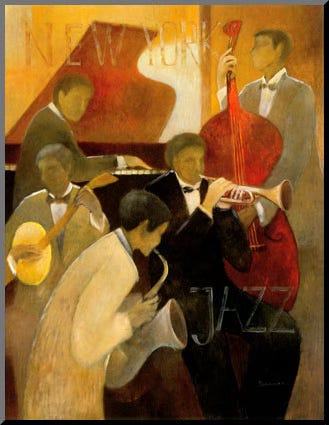
Jazz is the music that has taught me the most about discipleship. Jazz is always played with at least two players and as many as 50 or 100. Jazz helps us understand discipleship because it is an expression of freedom and new possibilities. A typical performance begins with the band playing a familiar melody; each playing their distinct part. After two are three times through the song, one of the players begins to improvise on the melody. As he or she plays with the theme, each of the other members of the band play supporting chords. As each player takes a turn at improvisation, he or she is supported by the band. All this requires skilled and close listening to one another. This process of listening and mutual support sets each player free to play with the music and see where it can lead them. The goal is to allow the music to take them to new places and new possibilities. All the practice, discipline, listening, and mutual respect for the music and one another gives the musicians freedom to get out of the way and allow the music to play them.